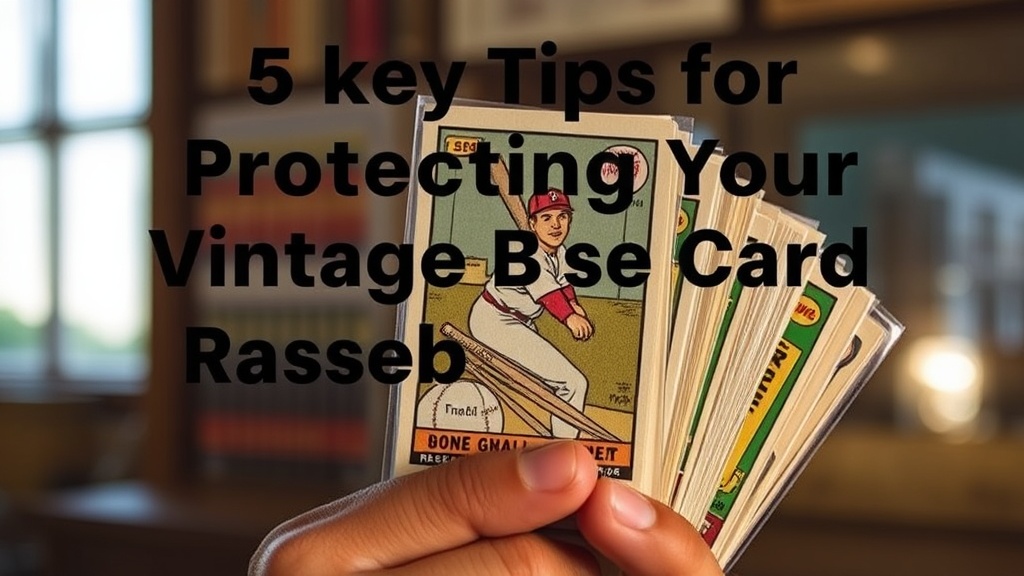
5 key Tips for Protecting Your Vintage Baseball Card Collection

Use Acid-Free Card Sleeves
Invest in Quality Top Loaders
Control Temperature and Humidity
Store Cards Upright in Sturdy Boxes
Handle Cards with Clean Hands or Gloves
Protecting vintage baseball cards isn't just about keeping them pretty — it's about preserving value, history, and the stories these cardboard treasures carry. Whether you've inherited a stack of 1950s Topps from a relative or spent years hunting down that perfect Mickey Mantle rookie, the way you store and handle these cards directly impacts their condition and worth. This post covers five practical, proven strategies for safeguarding your collection from the most common threats: light damage, moisture, physical wear, and improper handling. Here's how to keep your cards safe for decades to come.
What's the Best Way to Store Baseball Cards Long-Term?
The answer: controlled environment, proper supplies, and the right containers. Temperature fluctuations and humidity swings destroy cardboard faster than almost anything else. The ideal storage environment maintains a steady temperature between 60-70°F with relative humidity around 50%.
Card sleeves are your first line of defense. Start with penny sleeves — thin polyethylene sleeves that cost pennies each — for basic protection against fingerprints and surface scratches. For valuable vintage cards, upgrade to semi-rigid holders or one-touch magnetic cases. Here's the thing: not all sleeves are created equal. Cheap PVC sleeves off-gas chemicals that yellow and damage cards over time. Stick with brands like Ultra-PRO, BCW, or Card Saver — these use archival-safe polypropylene.
Storage boxes matter too. Cardboard shoeboxes from the closet? That's asking for trouble. They attract pests, lack structural integrity, and offer zero protection from moisture. Instead, invest in proper trading card storage boxes. The BCW 3,200-count Super Shoe Box runs about $15 and holds most collections comfortably. For high-value singles, consider Monster Storage Boxes or individual graded card cases.
Never store cards in attics, basements, or garages. These spaces experience wild temperature swings and humidity spikes. A closet inside the main living area works best. Keep boxes off the floor (in case of flooding) and away from exterior walls. Worth noting: direct sunlight fades colors in weeks, not years.
Storage Container Comparison
| Container Type | Best For | Price Range | Protection Level |
|---|---|---|---|
| Penny Sleeves | Common cards, bulk storage | $1-2 per 100 | Basic |
| Semi-Rigid Holders | Cards worth $20-200 | $15-25 per 200 | Good |
| One-Touch Magnetic | High-value cards, display | $3-8 each | Excellent |
| Graded Card Slabs | Premium cards, resale | $20-50+ grading fee | Maximum |
How Do You Handle Baseball Cards Without Damaging Them?
Clean hands and proper technique — that's it. Oils from skin transfer instantly to cardboard, leaving fingerprints that never come off. Even freshly washed hands retain natural oils. The solution? White cotton gloves or, more practically, handling cards only by their edges.
The catch? Most damage happens during casual browsing. Flipping through cards while watching TV, pulling stacks from boxes carelessly, sliding cards against each other — these habits cause edge wear, corner dings, and surface scratches. Vintage cards (pre-1980) especially suffer because the cardstock was thinner and less durable than modern equivalents.
When examining cards, work on a clean, soft surface. A microfiber cloth or playmat designed for card games provides cushioning if cards slip. Never slide cards across hard tabletops. Don't eat or drink nearby — one drop of coffee ruins a card forever.
For high-value vintage cards, consider wearing lint-free gloves. BCW's cotton inspection gloves cost around $5 and last years with occasional washing. The Ultra-PRO handling kit includes gloves, a cleaning cloth, and tweezers for precise placement. Speaking of tweezers — they work well for moving cards in and out of tight sleeves without touching surfaces.
If you plan to display cards, use UV-protective frames or cases. Regular glass blocks some UV light, but not enough for long-term exposure. PSA (Professional Sports Authenticator) recommends rotating displayed cards back into dark storage every few months to prevent fading.
Should You Get Your Vintage Baseball Cards Graded?
For cards worth over $50-100, grading often makes sense — but not always. Professional grading provides authentication (confirming your 1952 Topps Mantle isn't a reprint), assigns a numerical condition grade, and encapsulates the card in a tamper-evident plastic slab that protects against almost everything.
The three major grading companies are PSA, SGC (Sportscard Guaranty), and Beckett Grading Services (BGS). Each uses slightly different scales and criteria. PSA grades 1-10 with half-point increments at the higher end. SGC uses a 1-10 scale with distinctive gold labels. Beckett offers subgrades for centering, corners, edges, and surface — helpful for identifying specific flaws.
Here's the thing: grading isn't cheap. PSA charges $20-300+ per card depending on declared value and turnaround speed. SGC typically runs $15-25 per card. For a box of 1970s commons worth $2 each, grading destroys value. For a 1968 Nolan Ryan rookie in sharp condition? Grading can multiply value tenfold.
The encapsulation process itself provides excellent protection. Graded slabs are airtight, rigid, and stackable. They prevent bending, block UV light, and deter moisture. Some collectors even upgrade their slabs to GuardhouseGraded storage boxes designed specifically for PSA and SGC cases.
That said, raw (ungraded) cards in proper semi-rigids often suffice for personal collections. The choice depends on your goals — insurance documentation, eventual resale, or simply peace of mind.
What Environmental Threats Damage Baseball Cards Most?
Light, moisture, and pests — in that order. Light damage is cumulative and irreversible. UV rays break down inks and bleach cardboard. Even indoor lighting causes fading over years. Cards near windows suffer most. The solution is simple: store cards in darkness. When displaying, rotate pieces regularly and use UV-filtering glass or acrylic.
Moisture warps cardboard, promotes mold growth, and can fuse cards together. That basement storage unit? Temperature swings cause condensation inside sleeves. A card that looks perfect in summer might show water damage by spring. Silica gel packets help — toss a few in each storage box and replace them every 6-12 months. Brands like Dry-Packs sell rechargeable desiccant canisters that change color when saturated.
Pests pose a genuine threat. Silverfish love glue and paper. Cockroaches leave stains. Rodents chew through boxes. Once pests infest a collection, the damage is catastrophic. Prevention beats remediation every time. Store cards in sealed plastic bins rather than cardboard boxes if you live in areas with insect issues. Sterilite gasket boxes with locking lids provide excellent pest protection.
Worth noting: magnetic holders aren't airtight. Over years, micro-climates develop inside. Check stored cards annually — not obsessively, but a quick inspection catches problems early. Look for foxing (brown spots), edge waviness, or sleeve cloudiness. These early warning signs indicate environmental issues needing correction.
How Do You Organize a Growing Baseball Card Collection?
Organization isn't just neatness — it's protection. Cards crammed randomly into boxes rub against each other, corners catch on box edges, and valuable cards get lost among commons. A logical organization system minimizes handling and helps you find specific cards without rifling through everything.
Most collectors organize by year, then manufacturer, then card number. Your 1975 Topps set sits together, ordered 1-660. Modern collections might separate by brand — Topps, Bowman, Panini. Some collectors organize by player or team. The method matters less than consistency.
Use dividers. BCW Trading Card Dividers cost about $5 for 25 and let you label sections clearly. Tabbed dividers prevent over-handling cards at the front of sections searching for specific numbers. For sets-in-progress, consider keeping needed cards in a separate "want list" box rather than mixed with duplicates.
Track your collection. Spreadsheet, database app, or specialized software — pick something and use it. Trading Card Database offers free collection tracking with market values. Knowing what you own prevents accidental duplication (buying that 1969 Reggie Jackson a third time) and helps with insurance documentation. Speaking of insurance — high-value collections need rider policies. Standard homeowner's insurance often caps collectibles at $1,000-2,000. Document everything with photos and keep receipts for major purchases.
The best protection combines all these elements. Proper sleeves in quality boxes, stored in climate-controlled spaces, handled with care, organized logically, and insured appropriately. Vintage baseball cards survived 50-70 years to reach your collection. With these practices, they'll survive another 50 — and perhaps appreciate along the way.