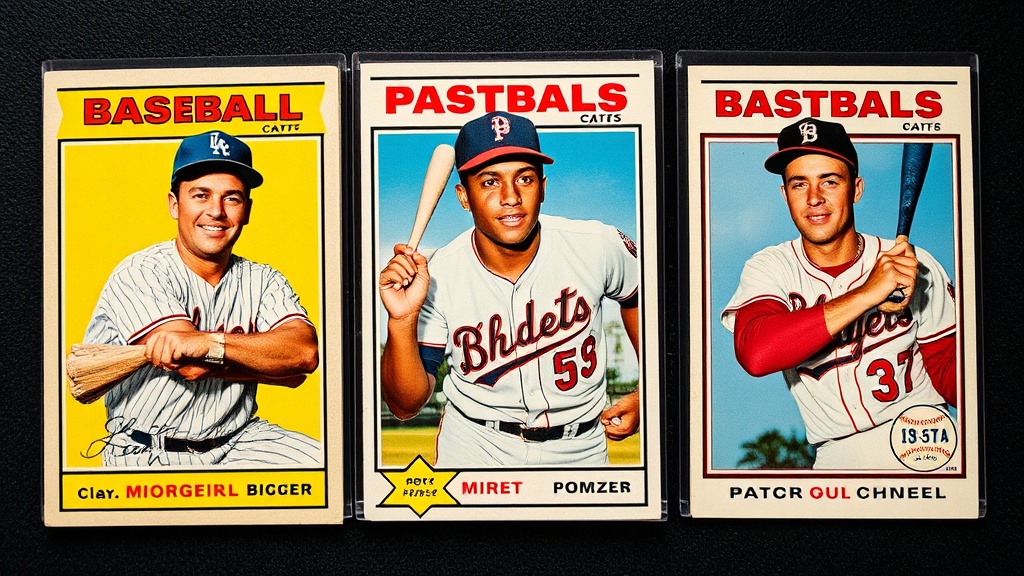
Legendary Baseball Cards That Changed the Hobby Forever

The T206 Honus Wagner: The Holy Grail
The 1952 Topps Mickey Mantle: A Golden Era Icon
The 1989 Upper Deck Ken Griffey Jr.: The Modern Revolution
This post examines the specific baseball card releases that fundamentally altered the collecting hobby, from the birth of the modern-day superstar card to the rise of high-end ultra-limited parallels. You'll see why certain sets became the gold standard for investors and how specific manufacturing shifts changed how we value cardboard forever.
Why are certain baseball cards more valuable than others?
The value of a baseball card is driven by a combination of scarcity, historical significance, and the player's performance. A card isn't just a piece of cardboard; it's a piece of history that represents a specific moment in time. When a player hits a home run or breaks a record, the demand for their cards spikes. But it isn't just about the player—it's about the set's rarity and the condition of the card itself.
Collectors look for "key" cards. These are the cards that define an era. If you're just starting out, you might want to read my guide on how to start a collection that gains value so you don't get caught up in hype without a plan.
The most important factor is often the "Pop Report"—the number of copies of a specific card that exist in high grades. A card might be common in a base set, but if it's a 1-of-1 parallel, the value changes completely. That's the difference between a $10 card and a $10,000 card.
The 1952 Topps Mickey Mantle
This is the undisputed king of the hobby. While it wasn't actually Mantle's rookie card (that distinction belongs to the 1951 Bowman), the 1952 Topps Mickey Mantle is the card that built the modern market. It represents the transition from simple trading cards to a high-stakes collectible. The sheer scale of the 1952 Tooping set—and the fact that many huge high-number series cases were actually dumped into the ocean—created a legendary scarcity. It’s the ultimate trophy for any serious collector.
The 1989 Upper Deck Baseball Card Set
Upper Deck didn't just release a new set in 1989; they revolutionized the entire industry. Before this, most cards were printed on cheap, dull cardboard. Upper Deck brought high-quality white paper, crisp photography, and—most importantly—the concept of "premium" collecting. This set changed the expectations of what a collector should receive in a pack. It made the hobby feel more professional and less like a toy.
What makes a card a "Rookie Card" (RC)?
A true Rookie Card is the first licensed card of a player produced by a major manufacturer during their debut season. It is the most sought-after card for any player's profile. If a player is a superstar, their RC is the one everyone wants to own. Sometimes, people mistake a "first appearance" card for a rookie card, but in the professional market, the distinction matters.
For example, the 1989 Upper Deck Ken Griffey Jr. card is often treated as the definitive rookie moment for that era. While there were earlier cards, the Griffey card became a cultural phenomenon. It wasn't just a card; it was a status symbol in the early 90s. It's the kind of card you'll see in museums or high-end auction houses years later.
It's worth noting that not all "rookie" cards are equal. A player might have a rookie card in a low-end set and a high-end "Bowman Chrome" card in the same year. The Chrome version is often the one that holds the most value because of the scarcity and the premium look of the card. (Always check the official Wikipedia entry for a specific set to verify the history of a card's release.)
| Era | Key Card Type | Primary Driver of Value | Impact on Hobby |
|---|---|---|---|
| Post-War (1950s) | Topps/Bowman High Numbers | Historical Scarcity | Established the "Blue Chip" card market. |
| The Junk Wax Era (1987-1994) | Base Card Sets | Volume/Nostalgia | Mass production led to a surplus of cards. |
| Modern Era (2000-Present) | Autographs & Parallels | Artificial Scarcity | Shifted focus to "hits" and ultra-limited items. |
How did the "Junk Wax" era change the market?
The Junk Wax era refers to the period in the late 1980s and early 1990s when card production went into overdrive. Manufacturers like Topps, Fleer, and Donruss were printing millions of copies of every single card. This resulted in a massive oversupply that actually hurt the hobby's long-term growth for a while. Collectors realized that "rare" wasn't actually rare if there were ten million copies of a player's card in existence.
This era taught the industry a hard lesson. If you want people to value your products, you can't just print everything in infinite quantities. This led to the birth of the "premium" era. We saw a shift toward limited-edition inserts, autograph cards, and serialized-numbered cards. The industry moved from "How many can we sell?" to "How many can we actually make?"
This shift is why modern collectors are so much more focused on specific subsets. You aren't just looking for a player's card; you're looking for the "Gold" version, the "Refractor" version, or the "1-of-1" version. It's a different way of thinking about a collection. It's almost like collecting art rather than just collecting sports memorabilia.
The Rise of the Bowman Era
Bowman has always been the gold standard for finding the next big thing. Their "Chrome" products changed the way collectors look at prospects. Before Bowman became a powerhouse, many collectors only cared about players once they reached the Major Leagues. Now, the "prospecting" game is huge. Collectors are hunting for cards of players still in the minor leagues, betting on their future success. This has created a massive secondary market for high-end prospect cards.
The Impact of Modern Technology and Grading
You can't talk about legendary cards without talking about the grading companies like PSA (Professional Sports Authenticator) or SGC. Technology has changed the way we verify a card's quality. In the old days, you just looked at a card and decided if it was "good." Now, we have professional-grade scrutiny. A card that looks "pretty good" might only get a PSA 8, while a perfect specimen gets a PSA 10. That one-point difference can mean thousands of dollars.
If you're looking to protect your high-grade cards, you need to be careful with how you handle them. I've written about choosing the right toploaders to ensure your gems stay in that pristine condition. Even a tiny scratch or a bit of corner wear can drop a card's grade and its value instantly.
- The 1952 Topps Era: Defined by iconic imagery and massive historical value.
- The 1989 Upper Deck Era: Introduced premium quality and standardized the modern collector experience.
- The Modern Parallel Era: Focused on serialized numbers, autographs, and extreme scarcity.
The history of baseball cards is a cycle of boom and bust. We saw the massive overproduction of the 90s, and we are currently seeing the massive "hype"-driven market of the 2020s. It's a wild time to be a collector. Whether you're chasing a vintage Mickey Mantle or a modern Shohei Ohtani rookie, the rules of the game are always shifting.